
Children’s Bedroom Ideas: How To Fit Four Kids in One Room (And Make It Work)
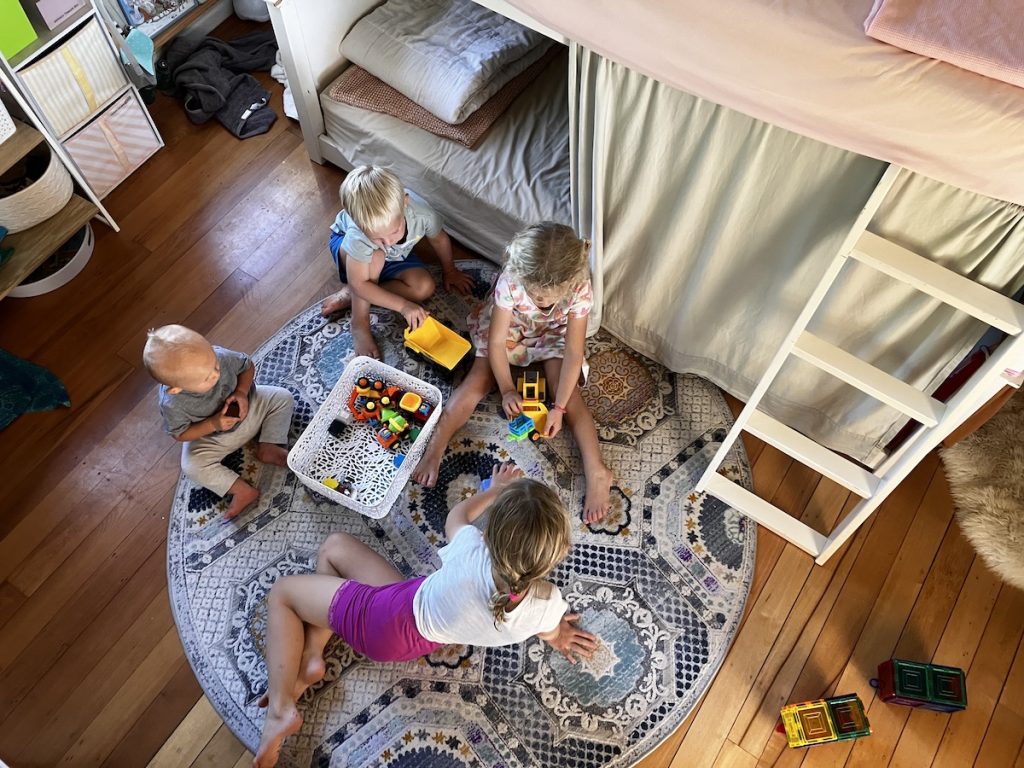
When you’re looking for real-life children’s bedroom ideas, it’s easy to get lost in scrolling endless Pinterest-perfect setups. But sometimes you want more than just curated photos and ideas.
While round up posts and stylized home decor websites can offer some great inspiration, I want to share about how our real family of 6, living in a 650 square foot cottage, function and thrive with four kids in one bedroom.
In this post I’ll shared a pictorial tour of our kids’ bedroom, as well as provide shared children’s bedroom ideas and principles that help this setup work for our family.
I hope it gives you some fresh ideas and leaves you encouraged that a small space can still hold big memories. And yes, even some peace and quiet now and then!
This post may contain affiliate links, which means I make a small commission at no extra cost to you. See my full disclosure here.

Why Our Family Choses a Shared Children’s Bedroom
For us, a shared children’s bedroom isn’t a compromise. Instead, it’s a proactive choice we have made for multiple reasons:
- A shared children’s bedroom is normal: growing up, my husband and I both shared rooms with our siblings. And throughout history, a sense of communal family living space has been the norm
- Sharing a bedroom encourages valuable life skills and connection: I believe that sharing a bedroom helped me learn tidiness skills, communication skills, flexibility, and generosity. And late night chats and getting ready together in the morning created a bond I still share with my sisters.
- A shared children’s bedroom saves us money: We live in a rented 2-bedroom home. Jumping up in size to a 3-bedroom home would cost approximately $280 more per week in our area. That adds up to over $14,000 per year.
- Shared bedrooms encourage simplicity: Since our kids are still quite young, managing their bedroom and stuff, keeping things organized and tidy, and regularly cleaning the kid’s bedroom is still mostly an adult responsibility. Having only one kids’ room to monitor and manage simplifies our lives and helps us maintain a minimalist lifestyle.
In the end, keeping our kids together in one room feels less like a limitation and more like an opportunity to live out the kind of family culture we want to build in this season of life.

5 Practical Principles for Small Children’s Bedroom Ideas
There are several practical principles we adhere to for maximum efficiency and usage. I would suggest that you start here if you are looking for shared children’s bedroom ideas to make your kid’s space really functional:

Shared Children’s Bedroom Ideas Practical Principle #1: Prioritize the Children’s Sleep Set Up First
Since beds are the largest items in a shared children’s bedroom, it makes sense to figure out their placement first. With doors, windows, and closets in the mix, this can take a bit of trial and error.
We use one set of bunk beds for our older two children (similar to this style – we just cut the legs off to make it extra low), which allows two beds in the footprint of one twin. The bunks also give each child a sense of separation since they don’t have to look at each other while falling asleep: a small win for smoother bedtimes.
For our three-year-old, we use a cot mattress on the floor, similar to this one. He rolls a lot in his sleep, so being low to the ground feels safest. He’s also nearly potty trained, so easy access in and out of bed helps with middle-of-the-night bathroom runs. Another perk is flexibility: we can move his mattress around as desired.
For our 17-month-old, we use a portable crib (ours seems to be slightly larger and sturdier than a pack-and-play – this one looks similar). It’s smaller than a full-size crib but still comfortable, and we can move it into our sleep out for nap times when needed.
When it comes to placement for our younger two, we’ve learned that some kind of visual barrier makes all the difference. If the boys can see each other from their beds, bedtime quickly spirals into silliness. A simple fix is clipping a blanket to the end of the crib to block the view. However we arrange things, keeping sight-lines separate is key to keeping bedtime (mostly) calm.

Shared Children’s Bedroom Ideas Practical Principle #2: Utilize Vertical Options for Storage
To be realistic, any shared children’s bedroom ideas need to address storage. When you have multiple kids in one room, you’re also storing multiple kids’ belongings, and that can get tricky fast!
We’re fortunate to have a good-sized closet in the kids’ room (2 feet deep by 6 feet wide), so we maximize every inch, especially the vertical space. Inside the closet, we have multiple levels of staggered rods and shelves, plus we’ve added slim shoe racks and small bookshelves to keep things organized.
(You can read more about our simple closet and kid’s clothes set up here.)
We also use vertical storage along one wall with floor-to-ceiling shelving. While it limits bed placement options, the payoff is huge: space for baskets, books, toys, and even our slim-line printer.
Simple vertical storage solutions also go a long way:
- Over-the-door hooks and shelves
- Command hooks (on walls, closet doors, and even furniture)
- Wall-mounted book rails
By leaning into vertical storage, we’ve been able to free up floor space and give every item a home. From closets to walls, doors to furniture, the “upward” approach has been essential for making our kids’ shared room both livable and functional.

Shared Children’s Bedroom Ideas Practical Principle #3: Keep Furniture as Minimal as Possible
Another practical shared children’s bedroom idea is to maintain as much open floor space as possible. The simplest way we’ve managed this is by minimizing bulky furniture.
For us, that has meant choosing a very basic bunk bed set. It doesn’t have built-in stairs or a fun slide (though my kids would love that!), but the slim frame and narrow ladder keep the footprint small.
Our 3-year-old sleeps on a mattress on the floor, which eliminates the need for a bulky bed frame and feels safer for a child who rolls in his sleep. This also gives us the option to set his mattress up on its end and lean it against the wall or move it to another location entirely to open up more floor space.
The portable crib for our toddler also takes up less room than a standard crib, while still being sturdy and functional.
I’ve also avoided dressers or anything with drawers that require extra clearance to open. Instead, we use open shelving, like cube shelves and slim bookcases, that can serve multiple purposes and adapt as our family’s needs change.
By keeping furniture simple, lightweight, and multipurpose, we’ve preserved floor space for what really matters: room for the kids to play, move, and live together comfortably.
FYI: I have a FREE PDF Guide for making a small, shared bedroom work for kids that gives some more in-depth ideas on this topic. If that’s of interest to you, you can grab it here:

Shared Children’s Bedroom Ideas Practical Principle #4: Create Personal Space for Each Child within the Shared Space
Since the bedroom itself is shared space, one of the biggest challenges with shared children’s bedroom ideas is giving each child a sense of personal space. Here are some ways we’ve made that happen:
- Ownership of their own bed. Each child has their own bed and gets to decide who does (or does not) come on it. This gives them autonomy over at least one space in the room.
- Privacy for changing. At this age, it’s not a daily concern, but sometimes one child requests privacy while changing. In those cases, we use the bathroom, our bedroom, or simply close the door to give them space.
- A shelf or “treasure box.” Each of the older three has a designated space for their personal treasures. My 3-year-old tucks away his water bottle, Duplo creations, and stuffed animals, while the older two each have a clear acrylic box of knick-knacks. As long as it fits in their space, I don’t interfere, and siblings know to leave it alone.
- Curtained beds. While not needed all the time, fabric dividers help transform shared space into little “kingdoms” if desired. The baby gets blankets clipped around his porta-cot, the 3-year-old has play scarves draped creatively, the 5-year-old’s top bunk can be curtained with a flat sheet, and the 7-year-old has a string-and-sheet setup with hooks in the ceiling that assembles in minutes.
Creating these small personal spaces within the room as part of our children’s bedroom ideas helps each child feel respected and at home, even in a shared bedroom.

Shared Children’s Bedroom Ideas Practical Principle #5: Monitor and Maintain for Simplicity
Of course, with kids ever-growing and developing, one of the most important children’s bedroom ideas is recognizing that maintenance is key to keeping the space functional.
While some one-time choices help (like choosing furniture wisely and sticking to open-ended toys for the family’s collection), we also do regular monitoring to ensure the kids’ small bedroom continues to work well for them.
- I usually keep at least one builder-type toy options (duplo, magnatiles, or train tracks) stored in the closet to rotate something “new” and exciting every few weeks.
- About every six months, I go through the kids’ clothes and do a “reset” to make sure what we have and need is stored and organized optimally in their closet.
- As needed, I prompt the kids to de-clutter their treasure boxes and personal spaces—especially when the lids won’t close or extra treasures are piling up outside the designated spots.
- Every night, as part of our bedtime routine, the kids tidy the bedroom and restore it to its “reset” state with all toys and clothes put away.
- Each Friday, as part of preparing for our family’s day of rest, we vacuum and mop the kids’ bedroom to keep it clean and fresh.
If you’re looking for even more strategies on making a shared bedroom work for your kids, check out our video with 13 practical tips on how to help your kids share a room peacefully.
Our Real-Life Setup: 4 Kids in One Room
Now that I’ve covered some of the guiding principles we’ve embraced behind how we set up our kids’ room, I’ll give you a walkthrough of how it is actually (currently) arranged!
For reference, the bedroom is 9 feet wide by 12 feet long, and the photo below shows the “floor plan” of the room:
When you step into the room, the wall to the right (pictured below) as you enter the bedroom is outfitted with floor-to-ceiling shelves. This is where we store some little-use household things (batteries, external hard drives, etc) on the top shelf, plenty of books, our printer, our 1-year-old’s clothes, the girls’ treasure boxes, and some of our favorite builder toys.
Moving to the long wall adjacent to the shelved wall (pictured below), the girls’ bunk beds are scooted against the wall and against the shelves. This does cut down on some of the shelves’ usability, but the placement makes the most sense to me for maintaining open floor space, which is one of my top priorities.

At the end of the bunk beds, we have the portable crib set up for the one-year-old (pictured below). And next to the crib is a little “reading nook” with a chair and picture-rail shelves below the window for easy access. Above the reading nook is where we hang my husband’s guitar and ukelele (since this bedroom used to be our bedroom).
Turning the corner, the wall opposite the bedroom door (pictured below) has a large window.
Underneath the window we have a small cube shelf for books, ballet clothes, and my 3-year-old’s personal space. And my son’s mattress is next to the cube shelf.

Most of the last long wall is made up of closet space (pictured below), which stores clothes, bed linens for the whole house, additional toys, our family’s folding table and folding chairs, sewing kit, and some off season clothes and rarely used items.

The last stretch of wall has some ink sketches of my older three kids at age 2, which are some of my favorite decor pieces in the house.
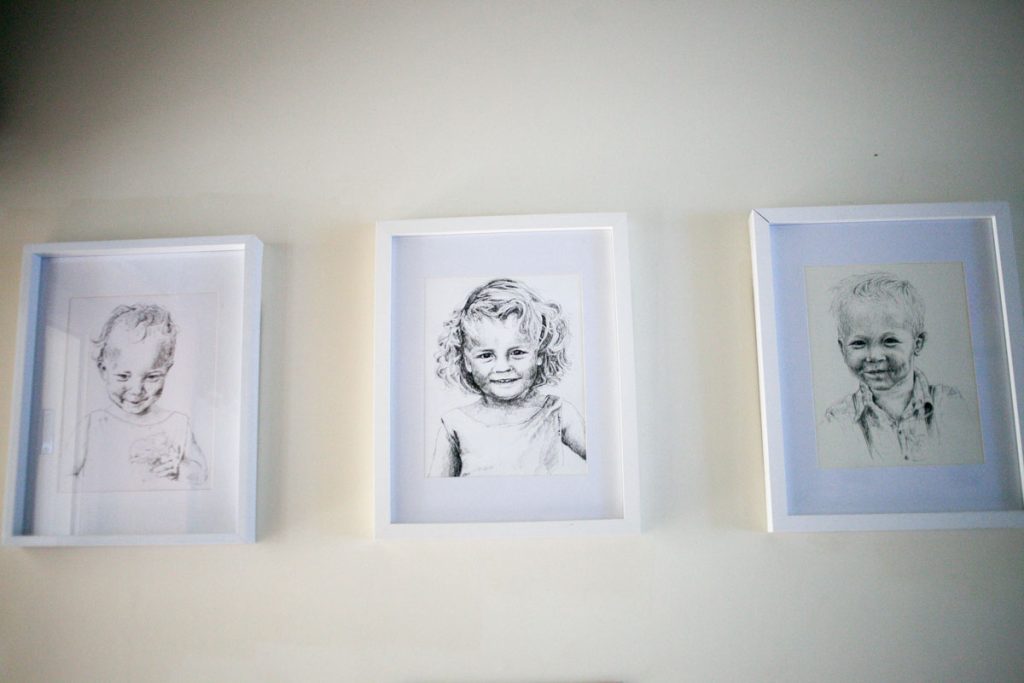
Altogether, this layout allows us to keep the room functional, maximize open floor space, and make sure the kids’ shared bedroom feels both practical and cozy for our family.
Our Shared Children’s Bedroom Ideas Video Walkthrough:
This walkthrough shows a slightly older version of our kids’ bedroom layout, but the storage and configuration are still pretty similar.
At the time of filming, our youngest slept in an infant sleep hammock (which we have used with all four kids, and we love it for a small space!), so we had shifted the bunkbeds a bit in order to hang the hammock securely from the ceiling.
What We’d Change If We Had More Space:
While we’ve made this setup work well for our family (and even discovered many advantages to it), I’ll admit that it does come with some challenges. Since we won’t be in this cottage forever, there are a few children’s bedroom ideas I’d like to keep in mind for the future:
- A Separate Nursery: We technically could use our detached sleepout as a third bedroom, and I do during postpartum recovery. But since we don’t use it full time for the kids, the first year of a baby’s life is especially challenging for sleep. Babies under one tend to run on their own schedule, and I’d love to have a nursery right next to our bedroom for our next baby (due in January 2026)—close enough for easy access at night, but with a door to provide a bit of a sound barrier.
- A Little More Distance Between the Common Area and the Shared Children’s Bedroom: Since our only common area is right outside the children’s room, any early morning noise tends to disturb kids still sleeping. Even with sound machines, we often find ourselves tip-toeing and whispering despite all our children’s bedroom ideas in the early mornings, evenings, or during naps.
- A Slightly Wider Shared Children’s Bedroom: At 9 by 12 feet, the room is functional, especially with smaller beds for the younger kids. But a few extra feet of width would make bed placement easier and give us more flexibility as the kids grow.
Even though these are things I’d change if I could, none of them make our current setup unworkable—and living small has taught us that even imperfect spaces can serve a family well with a little creativity. For now, we’re embracing this season for what it is, and making the most of the space we do have with these children’s bedroom ideas.

My Encouragements If You Are Making a Shared Children’s Bedroom Work:
If you feel overwhelmed or guilty that you can’t give each child their own room, I promise, your children really will be OK!
Small, shared spaces can be cozy, bonding, and even freeing. As long as your children are safe with each other in the space, the interpersonal experiences you are providing them are at least as valuable as a customized, personalized, individualized bedroom.
In fact, you’re teaching your kids life-giving values: like flexibility, consideration for others, gratitude for what they have, and the ability to share space with love. Those are lessons they’ll carry with them and benefit from long after they’ve outgrown this season.
So if a shared children’s bedroom is your reality right now, lean into it. With a little creativity and perspective—and the right children’s bedroom ideas—it can become one of the most memorable and meaningful parts of their childhood.

Final Thoughts on Real-Life Children’s Bedroom Ideas
At the end of the day, children’s bedroom ideas don’t have to come from glossy catalogs or perfectly staged Pinterest boards. Sometimes the best inspiration comes from real families making the most of their space.
Our kids’ shared bedroom is far from picture-perfect, but it works, and more than that, it gives our children daily opportunities to grow in flexibility, generosity, and connection.
Whether you have two kids sharing a room or four like we do, the principles remain the same: think creatively about furniture, maximize vertical storage, protect a little personal space for each child, and keep things simple enough that the room serves your family rather than overwhelming you.
I hope our experience and children’s bedroom ideas encourages you that a shared bedroom isn’t second best. With a little thought and intention, it can become a cozy, functional, and memorable part of your family life.
Want even more practical tips for shared spaces? Don’t forget you can grab my 8-page free PDF guide with extra ideas to make shared bedrooms and family spaces work smoothly. Access it using the form below!