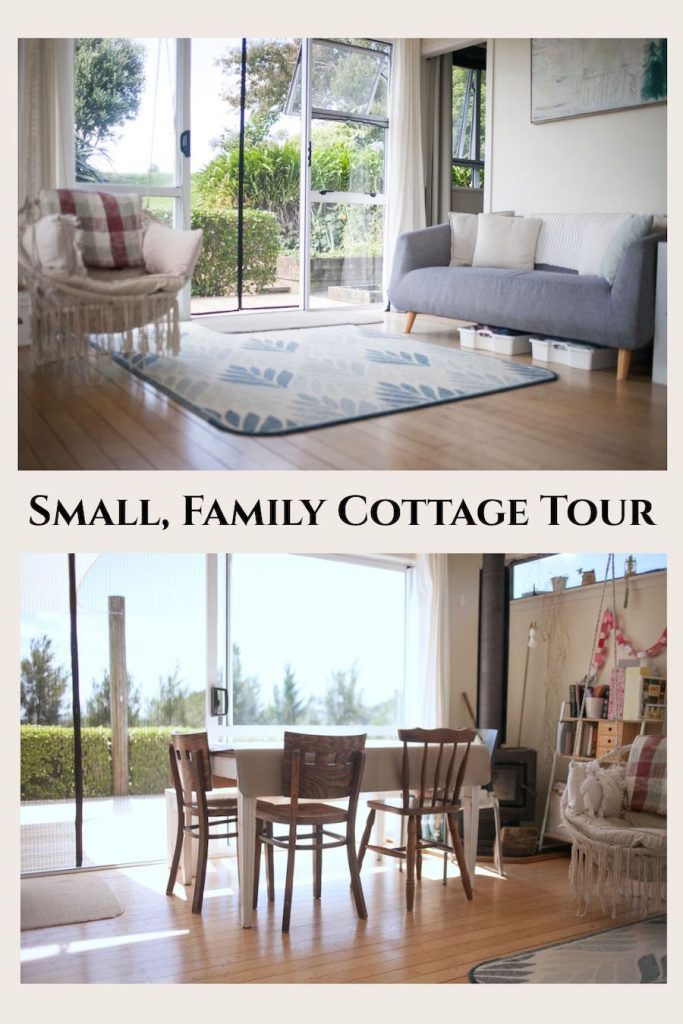
Small Cottage House Plans: How to Live as a Family of 6 in 650 Sq Ft
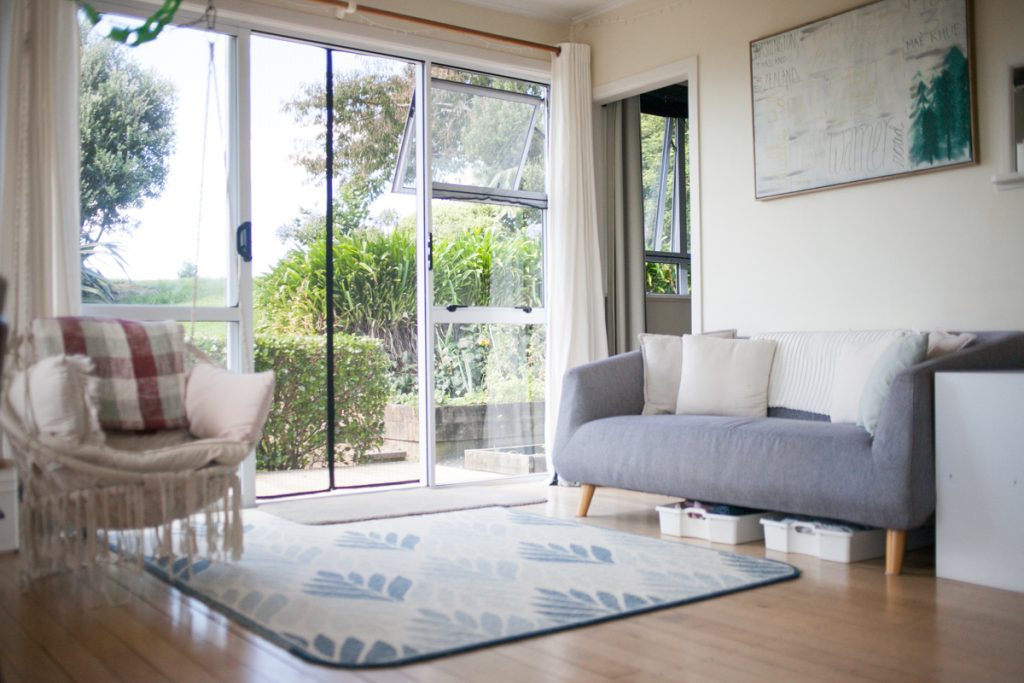
Are you looking for a layout of house plans for how a family of six lives in a small cottage? Or maybe you’re wondering how a family with multiple young kids makes it work in a little house? If so, welcome! I’d love to share our small, 650 square foot cottage with you, where we lived for almost two years as a family of six.
When we first moved into our little, rented country cottage, we were a family of four. Since then, we’ve welcomed three more babies.
Somehow, this same 650 square foot cottage has adapted and continued to exemplify “home” for us. We’ve adjusted, rearranged, and simplified to make the space work for our growing family.
I’ve shared our cottage house tour when we were a family of five. But since we made some changes to adapt to having four children, I want to share an update of our how our cottage worked for us after our fourth baby was born.
Our Small House Philosophy: Why We Chose to Stay in a Small Cottage
We had several significant reasons why we chose to stay in our small cottage, even as our family grew.
- Personal Preference: my husband and I have always desired to live intentionally, and that has included within our physical home. While we aren’t extreme minimalists, we enjoy the challenge as well as the sense of freedom that comes from having only what we need and can easily manage.
- Location: when we moved in to our cottage, we moved from down the road (where we lived in a smaller footprint Granny flat for several years). The move brought us closer to my husband’s workplace (which was basically next door), and allowed us to live within walking distance of his work place as well as walking distance of several dear friends.
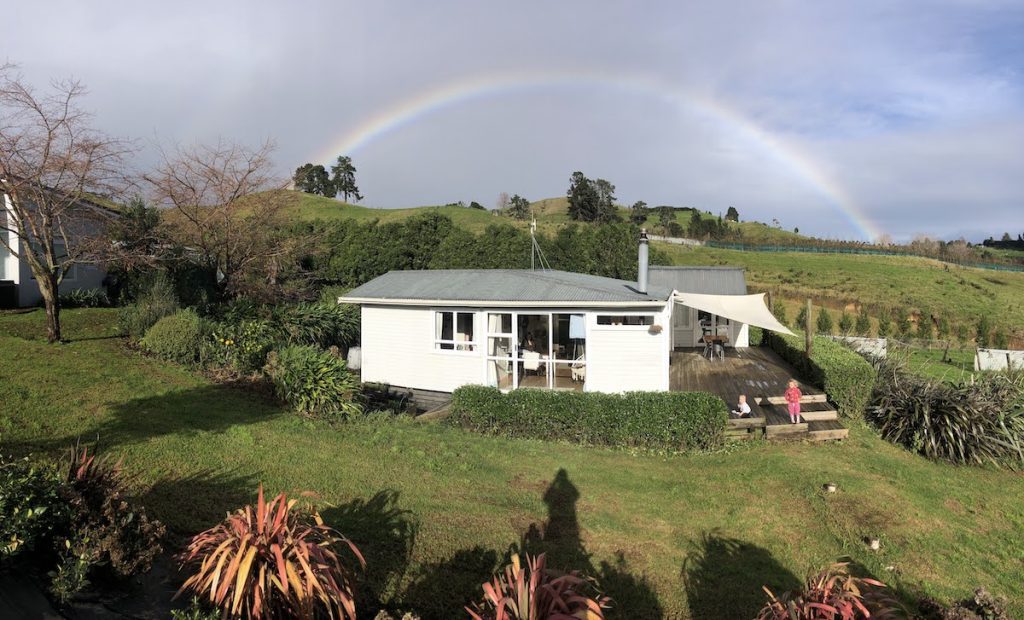
- Rural Lifestyle: a big bonus for us about this cottage is having yard space for our kids to play outside, as well as a very large deck. Both things make this home, although it is small, very practical and positive for our family.
- Financial Priorities: since we live overseas from our extended family, we channel a decent amount of our annual income in to a savings account to save up to fly our family home every 2 years or so. We also have chosen for me to stay at home with our kids to be their primary caregiver and homeschool our children, which means we live on one income. Both of these priorities (visiting our families back in the USA and keeping me home with our kids) meant that we needed to keep our costs of living on the lower side of things. A small space = less to furnish, less to heat, and ultimately, less floorspace to pay rent.
Our Small Cottage Layout:
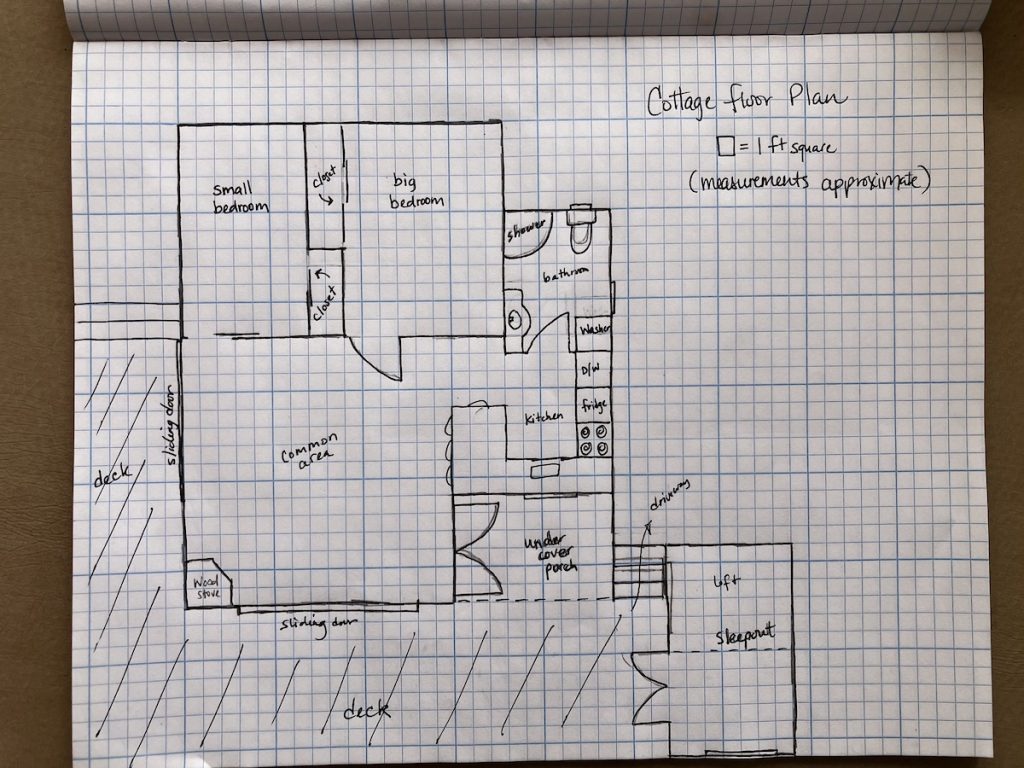
Our cottage packs in a lot of efficient space, even though it is small. Some basic aspects of our cottage house plan include:
- one main living space, which includes our entry, dining space, lounge/living space, and the kitchen area.
- two bedrooms that open directly into the living space: one is about 9×12 feet, and the other is a small bedroom that is about 6.5×12 feet.
- one bathroom with a small corner shower and space for a washing machine
- a small “sleepout” building, which provides an additional 100 square feet of space + a little loft (detached from the main building, but only about 4 feet from our side wall, opening onto the deck)
Some observations I’ve made about this cottage that help it function well and feel pleasant to live in:
- There are no hallways – all of the movement from one room to another happens through the common area, which means there isn’t a lot of wasted floor space
- Our common area has two walls that are basically huge sliding doors. This provides a LOT of natural light and visual openness when you’re inside the house
- The footprint of our cottage is essentially a square, which I think makes a more efficient floor plan than long-skinny rectangles or “L” shaped buildings.
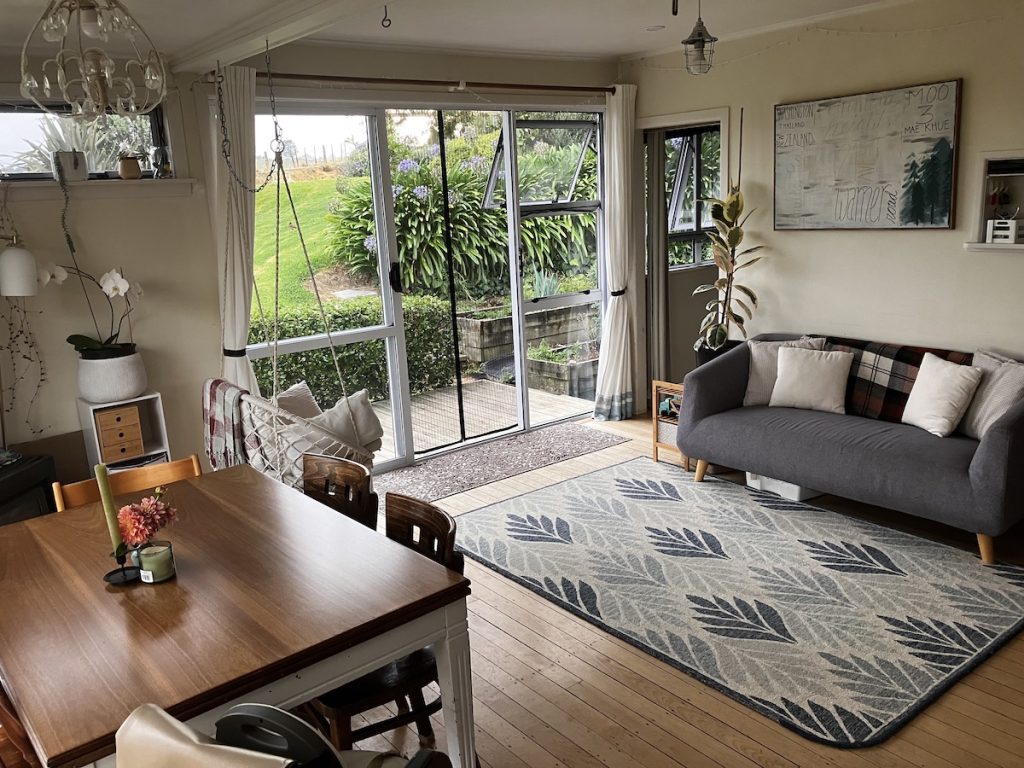
Living Room+Dining Room Layout of our Small Cottage (Main Family Space)
When you enter our house, you come directly into the main common space. This space functions for the following uses:
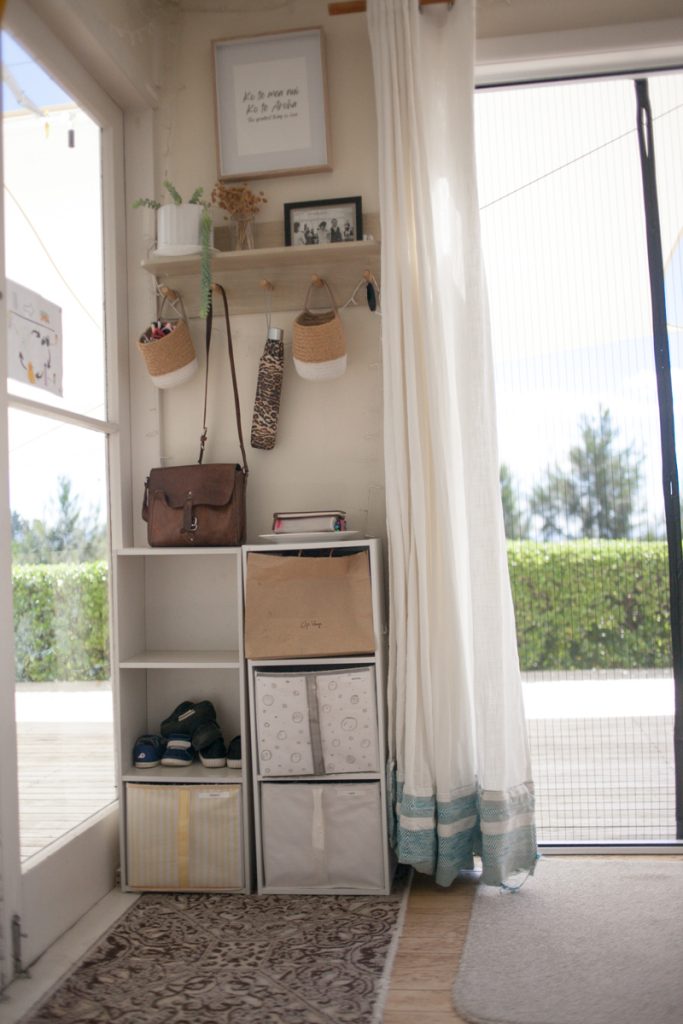
Mudroom:
We have a small entry just inside our little covered porch area. I keep our kids’ shoes here, some hooks for hanging hats or purses, and a shelf for keeping our car keys. The laundry line is just outside our front door, along with several shoe racks, which means we can hang up wet clothing outside to drip dry, and wet boots or shoes have a place to dry undercover without bringing them inside.
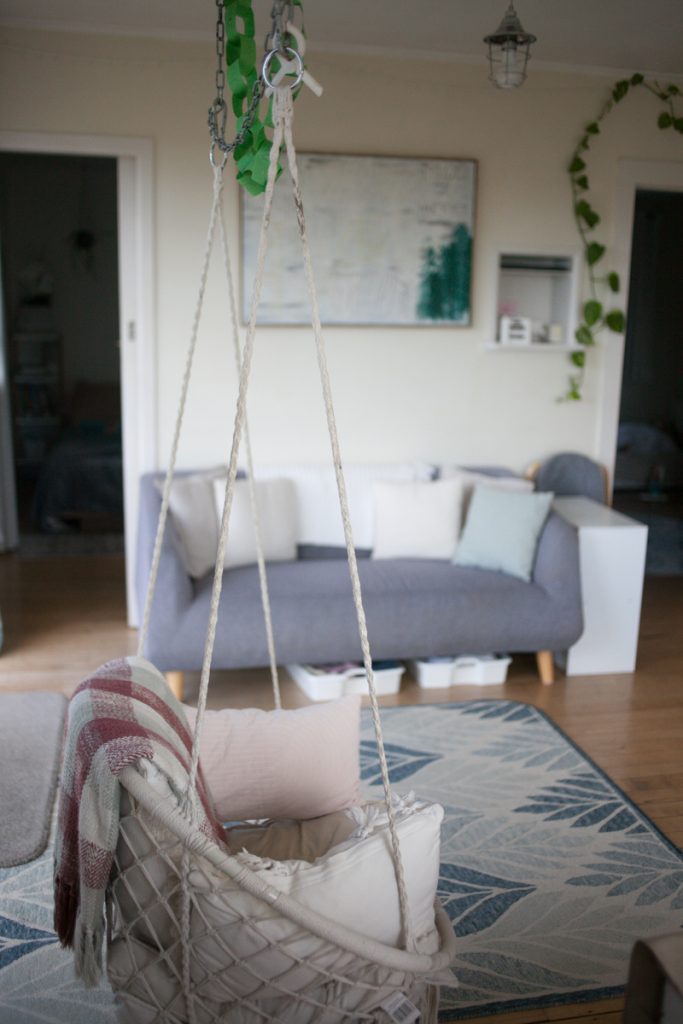
Living Room:
Our living room furniture is minimal (a large area rug, a small couch, and a hanging hammock chair), which means it can share the space with the dining room table. During the winter, we position the couch and rug near to the wood stove, and hang the hammock chair at an angle facing the couch for pleasant conversation. The couch ends up being right next to one of the large sliding doors, which means we can capitalize on the sunlight in the winter to help warm up the sitting space.
During the summer, we swap the room so that the couch is against the interior wall in the living room, away from the more intense summer sun, and the dining room table is next to the large sliding door so we can most conveniently pick up the table and move it outside to the deck to dine al fresco.
Our family can fit on the furniture we have, and when we have company, we simply flip around a dining room chair to provide additional seating.
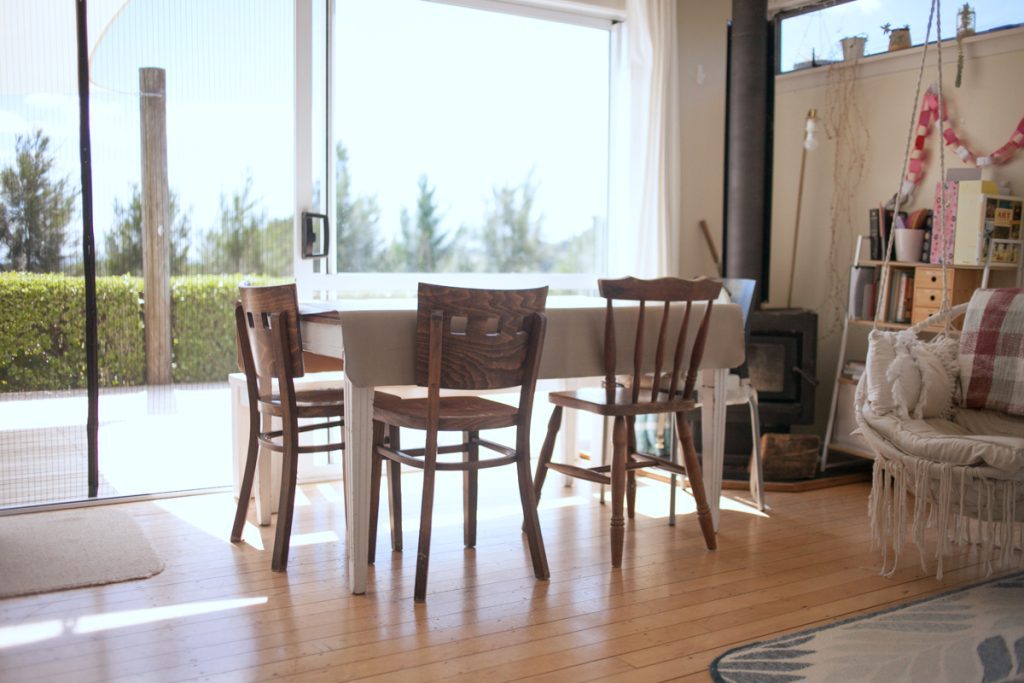
Dining Room:
The other half of the common space is our dining area, which doubles as a homeschool space between meals. We have a 4-foot table, which can expand out to about 6 feet if needed. We keep a chair with a child’s booster seat at one end of the table, a bench along one side, and 3 chairs to provide sides on the other end of the table and the other side of the table.
I don’t have a separate high chair, because there isn’t room. Instead, I keep a booster seat that can fold down and slide under the edge of the table. Once our kids are old enough to sit up and start eating solids, we move them straight to the booster. Initially with a little tray, and once they reach about 1 year, they just sit at the table with us.
The dining room table is also where we usually fold laundry, play games, work on projects, or the kids do arts and crafts. We just don’t keep things out on the dining room table.
You can view the full common space tour here.

Kids Sleeping Spaces:
When we had two and then three children, they shared the smaller of the two bedrooms, utilizing a bunk bed and a port-a-cot and then later a crib mattress on the floor.
After adding our fourth child, once we were ready to move him out of our bedroom at about 6 or 7 months, we swapped rooms so that the larger of the two bedrooms became the kids’s room.
Our older two girls share a bunk bed which we modified when they were young to be lower to the ground. Cutting off the legs of the bottom bunk meant we forfeited storage space under the bed, but that was fine for us.
Our third slept on the crib mattress he used in the smaller room. Utilizing a crib mattress meant he could easily get in and out of bed himself (very useful for potty training), and it could be lifted up and set against the wall during the day to open up a bit more floor space.
The baby continued to sleep in his hammock until he was about one-year-old, and then we moved him to a port-a-cot. We love using the infant sleep hammocks for our babies because they take up less floor space than a bassinet or crib or port-a-cot.
The interior wall with the door on it has floor to ceiling shelves, which provide a lot of storage space for books, toys, and even the baby’s clothes.
We tried to maximize open floor space for the kids to have room to play on the rug in their bedroom, since it is helpful to have a couple different locations inside the house for playing on rainy days.
You can view the kids’ room tour here.

Our Sleeping Space:
We downsized from a King bed to a Queen bed when we moved into the smaller bedroom so it would fit in the space and provide a little standing room on each side of the bed.
I also invested in a Japanese-style platform bed frame that allowed us to slide between the wall and the bed without risk of stubbing our toes on legs of the bed.
We keep a small shoe rack in front of the sliding door in order to have a spot to store socks, slippers, and some workout gear. I can still lay out my yoga mat at the end of the bed and get a good workout in, even with the limited floor space!
You can view our bedroom tour here.

Our Small Cottage Kitchen + Food Storage
Although our kitchen isn’t large, I cook the vast majority of our food here, proving that you don’t necessarily need a large space in order to utilize your kitchen well!
We keep our appliances relatively minimal, with the heavy hitters being our blender, our crockpot, our toasted, and a tea kettle. We also have a microwave tucked into the bottom shelf of our pantry cupboard, and a dishwasher that fits in the bottom of the pantry area.
For our food storage, I use our large cube shelf to keep fresh fruit handy, and we also lean in to a lot of frozen vegetable, both for cost-friendly purposes as well as ease of storing the produce. We have both the freezer on top of our fridge, as well as a 5 foot tall stand-up freezer outside in our woodshed.
I try to keep our cooking equipment streamlined and minimal as well.
In general, we try to adhere to the “space boundary” ideas in our home, and particularly in our kitchen: if it doesn’t easily fit, something has to go away to make room, or we can do without it.
I keep some bulk foods out in our sleep out storage area to streamline our kitchen space as well.
You can view our kitchen tour here.

The Sleep Out Space (Flexible Storage for our Small Cottage)
We have a little building off the side of our small cottage deck which is detached from our cottage but functions as an additional bedroom or guest room or office space. It is, essentially, a flexible spot for us to utilize as needed.
This space serves MANY purposes, including an extra play room for the kids, an office space for my husband or me, storage spot for bulk foods and kids’ clothes that are off season or not the right size, and a guest room for visitors.
There is a loft over half of the little building which our girls love to use for their doll kingdom, as it is out of reach of little brothers, and they can leave it set up multiple days in a row (which is challenging in the rest of our home!).
It is extremely helpful to have this “bonus” space because it can serve so many functions.
You can view a tour of this space here.

Storage Solutions That Make Small Cottage Living Work:
I love trying to maximize our space for the season we are currently in. As a result, our small cottage has actually evolved quite a bit over the four years we have lived here. Some things that I always come back to when it comes to making this space work for us are:
- Vertical Storage: shelves in the kids’ room, hooks on the back of doors, utilizing our top closet shelves, and our tall cube shelf have helped provide storage for us.
- Modern Style Furniture: having a couch with room under it for trays, a platform bed, and utilizing a Montessori style approach to kids’ beds has helped make the most of the space.
- Open-Ended Toys: I’m a big fan of keeping a relatively minimal amount of open-ended toys. They work well for multiple ages, they evolve with the kids so you don’t need to replace them, and you can get away with fewer toys because they have more variety of application.
- Minimal(ish) Wardrobes: we aren’t extremely minimalists, but having about 10 changes of clothes for our kids, 3-4 pair of shoes, one jacket, one sun hat, 2-3 swimsuits, etc, has helped us keep clothing storage under control.
- Neutral/Unified Color Palette: keeping things out on display that aren’t super bright or clashing with the other decor in the house helps to keep the visual peace, even when storing things out in the open.

What We’ve Changed in our Small Cottage Since Adding Two More Kids
Our small cottage space continues to evolve to fit our needs, so there is actually quite a bit different from when we originally moved in. Specifically, we’ve added:
- Large floor rugs. We started with smaller rugs, but since our floors are wooden, I found our kids were always crowding onto the small rug to play on the floor. Buying larger rugs to provide more carpeted floor space has made our small cottage continue to work for us better.
- A tall cube shelf. Adding it to our home has provided much more functional storage space in our common area.
- Switching bedrooms. Giving our kids the larger room made sense since that room needed to fit four people, each with their own bed space, rather than just two people sharing a bed.
- Moving away from dressers. We did have a small dresser for awhile which held the kids’ clothes, but over time we decided it made more sense to have open shelves and baskets to that the kids could more easily access their clothes without risking pinched fingers, we didn’t need as much space in front of the shelf to open the drawers, and we could customize the baskets we used to fit the space we needed for the clothes we had.
- Utilizing an expanding table and a bench. When we first moved in, we had a smaller table. I waited and hunted facebook marketplace to find our current table, and the thing I liked about it was that it expanded to be longer when we needed it, but in its smallest state, it was still large enough to seat our family. Adding a long bench means we can crowd a few more people (especially kids) around the table when needed.
If you’d like to see a video tour of our cottage, feel free to check out my youtube channel with a walk through of our cottage:
Final Thoughts on Living in a Small Cottage as a Family of Six
Living in a small cottage with a big family isn’t always easy. Sometimes there is a lot of noise, and sometimes we have to get really creative about how to make sure everyone gets some quiet space.
But it has been one of the sweetest gifts of our family life. Our kids are close, our home is full of life, and we’ve learned that we can comfortably and peacefully live with far less space and stuff than many Americans consider “normal.” And that has brought many areas of peace and freedom into our life.
I hope if you are considering living in a small space, this post and tour of our home has been encouraging to you. I would love to hear from you in the comments below. Let me know if anything specific inspired you or if you have experience living in a small space!