
How to Launch the Homeschool Year with Calm and Confidence

Do you want to launch the homeschool year in a way that sets you up for a peaceful daily homeschool schedule and rhythm? I think most seasoned homeschool moms know what it is like to attempt a school year launch with a full schedule and high expectations… and then crashed and burned by about day three!
But it doesn’t have to be that way! In this post I’m sharing how to start the homeschool year using my strategy of a soft start to homeschooling during the first week.
And if you prefer to learn via video, I’ve created a masterclass packed FULL of information on how to launch the school year smoothly. You can check it out here:

Conquer the Chaos Mini-Course: Time Management, Home Organization, and Mindset Strategies for Homeschooling Moms
Conquer the Chaos is a practical, inspiring, and grace-filled mini-course designed to help homeschooling moms bring calm, clarity, and confidence back into their days. Learn simple time management strategies, home organization systems, and mindset shifts that actually work with babies and toddlers underfoot.
Having grown up homeschooling with a couple rounds of the crash-and-burn schedule, I’ve followed the strategy I’m outlining in this blog post for the past few years, and it has worked beautifully for our family.
And, of course, getting off to a solid start is a huge benefit to your homeschool year:
- your kids know what to expect
- it helps you streamline and refine your systems and routines
- it sets your baseline standard to return to when life inevitably happens and your schedule gets a bit wonky (because, let’s be real, that is going to happen!).
Specifically, in this post we’ll be looking at how to set up your school year over a 3-week period, the value of teaching and training your kids for the school year’s rhythms BEFORE you jump into the academic learning, and some of my simple systems that help our days flow smoothly.
So let’s dive in to some real, actionable, practical ways you can launch your homeschool year successfully.
And if this blog post is helpful for you, you may enjoy some of my other homeschooling content as well or the printable PDF Planner I designed to support my homeschool organization!

A Simple, 3-Week Timeline to Launch the Homeschool Year Smoothly
I approach the homeschool year with a 3-week “launch” timeline.
If you prefer a video format, you can watch this youtube video where I explain what this looks like for us! If you’re more of a speed reader, feel free to continue on below!
This is what it looks like:
Week 1: Practical Preparation Week for Mom (2 weeks before the “first day of school”):
By this point, I’ve already chosen our curriculum and set big-picture goals. This week is about breaking those goals down into a realistic, daily rhythm.
I begin with a calendar overview: I block off breaks (holidays, trips, visitors) and make sure we still have enough weeks to meet legal requirements. Then I divide the total number of lessons in each subject by the number of school weeks. That tells me how much we need to cover weekly.
Next, I outline a weekly structure, choosing four core school days and one built-in flex/catch-up day. This margin gives me breathing room when real life happens, as it always does!
Then I rank our core subjects (math, language arts, science, social studies, Bible) by priority. We always start with the highest priority subject each day.
With that in place, I build our ideal daily flow, using natural anchors like breakfast, lunch, and dinner (and baby/toddler nap times, if needed). I ask: What tasks keep our home and school running? When do they need to happen?
From there, I create our daily chore list, broken into before/after each anchor point. I assign age-appropriate chores to each family member so everyone knows their role.
Finally, I make sure everything is ready:
✔️ Each child’s materials are color-coded
✔️ Basic supplies are stocked and accessible
✔️ Each child’s chore chart is created, printed, and posted.
This foundation sets us up for smoother days and less mental load when school officially begins.

Week 2: Soft Start Week Focusing on Teaching Daily Rhythms and Tasks (1 week before the “first day of school”):
The purpose of this week is simple but extremely intentional: to teach the flow of our homeschooling day before we begin academic work.
Because my kids are still young (currently 7, 5, 3, and 1), their skills and responsibilities are constantly growing. So this is the week I revisit, refine, and train daily routines.
On Monday, we walk through our daily timeline and chore charts. We talk about what needs to happen before and after meals, during transitions, and throughout the day.
If anyone is learning a new responsibility, I use a simple 4-step training method:
- Explain & Model — I show them how to do the task and what “done well” looks like.
- Do It Together — We complete it side by side, focusing on quality.
- They Lead, I Assist — They try it while I support or give reminders.
- They Do It Alone — I check the results and offer feedback or retraining if needed.
Throughout the week, we practice these chores in real-time, during the same moments they’ll happen in our homeschool days (before breakfast, after lunch, etc.). This helps the whole flow feel familiar once school starts.
Those first couple days are usually slow! But that’s the point. This week gives us space to train well, so the academic learning can happen smoothly later.
I also do practical prep during this week: I color code each child’s workbooks and orient them to where the books and school supplies are stored.
And I do a “beginning of the year snapshot” for each child, where I interview each child on their interests and favorites and record their answers, we measure their height and weight, and I get a photo of each child. This goes into our homeschooling records.

Week 3: Official Start Week to School Year Academics (the “first week of school”):
After a week of dialing in our routines and rhythms and learning our chores, we launch the (academic) school year.
Focusing on those priority subjects, I look at this week as five opportunities to practice the practical skills the kids learned the week before and layer our academic subjects on to that rhythm.
It still takes a few days to fully hit our stride, but the gradual, intentional approach seems to work the best for us!
I try to keep our other commitments (appointments, social events, play dates, etc) to a minimum this week, so we can really focus on our daily routine, including wake up times, bed times, and meal times.
We like to wrap up the week with our Friday “sabbath launch” meal, including a candle lit dinner and some kind of dessert. And this end-of-the-week dinner is also a time to celebrate the work and effort our family has put in to launch the homeschool year.

4 Systems to Set the Tone for Your Homeschooling and Launch the Homeschool Year:
These are four systems I’ve found to be helpful setting the tone to launch the homeschool year, and I hope they give you some homeschool rhythm ideas.
1. Create a Daily Flow
Clarify what your homeschool days are going to look like, and streamline what you can.
Repetition and routine are very helpful for our home! So the kids come out of their bedroom (when the sound machine goes off) every morning, and then we transition to the same pre-breakfast chores each day.
I’ve tried to streamline breakfast by making a simple rotation of meals that we cycle through during the school week. I start the school day over the breakfast table with some readings while the kids’ hands and mouths are busy.
The kids then move on to their after breakfast chores, while I clean up breakfast, and then we sit down for workbook time, which is also when I often fold some laundry or do other low-brain-work household tasks at the dining room table with the kids.
Then we’re wrapping up school and moving on toward before-lunch-chores and our afternoon.
Some people might find it helpful to create an actual flow chart to follow each day – if that’s you, go for it! I end up essentially time blocking our day and using our chore chart to help us define what are the tasks that need to be done around our “anchor” time points in the day.
I’ve created a video about how we execute our chore system, so if you want to deep dive more into this, feel free to check out this video:
This system helps the kids and I know what needs to happen throughout the day.
Of course, a little bit of flexibility is key! I don’t necessarily set hard and fast “times” for each anchor point to happen. Instead, I try to establish the routines of what happens first, then second, then third, and so on.

2. Color Code Materials to Simplify and Launch the Homeschool Year:
I’ve found being able to visually identify books or workbooks that are specific to each child is helpful with simplifying and streamlining the homeschool day.
I give more details about this system in my post on Homeschooling in a Small Space, so if you want more details, feel free to check it out there (it’s Tip #5). But basically, to launch the homeschool year, I color the side of each workbook (the ends of the pages) a specific color for each child. My kindergartener’s color is red, and my 2nd grader’s is yellow.
This makes it easy and simple to grab the correct books for each child.
3. Plan for Margin as you Launch the Homeschool Year:
My main form of doing this is by planning a four-day school week. Fridays are our day set aside for cleaning the house, running errands, or catching up on school work as needed.
However, the secondary way I do this is by planning to only finish 3 lessons of math and language arts for each child each week.
We often get those three lessons done by Wednesday, which means we either work ahead on Thursday in those subjects, or we catch up on or deep dive into other subjects. This works for our lives and schedule, and the margin gives me peace of mind when unexpected things come up.
4. Weekly Planning/Check In Time for Mom
Another system that brings peace of mind and helps me launch the homeschool year smoothly is a Sunday afternoon or evening planning session and check in time for me.
My husband and I run our weekly schedule Sunday through Friday, and then take Friday night to Saturday night as an intentional rest.
As a result, Sunday becomes our “set up for the week” task day.
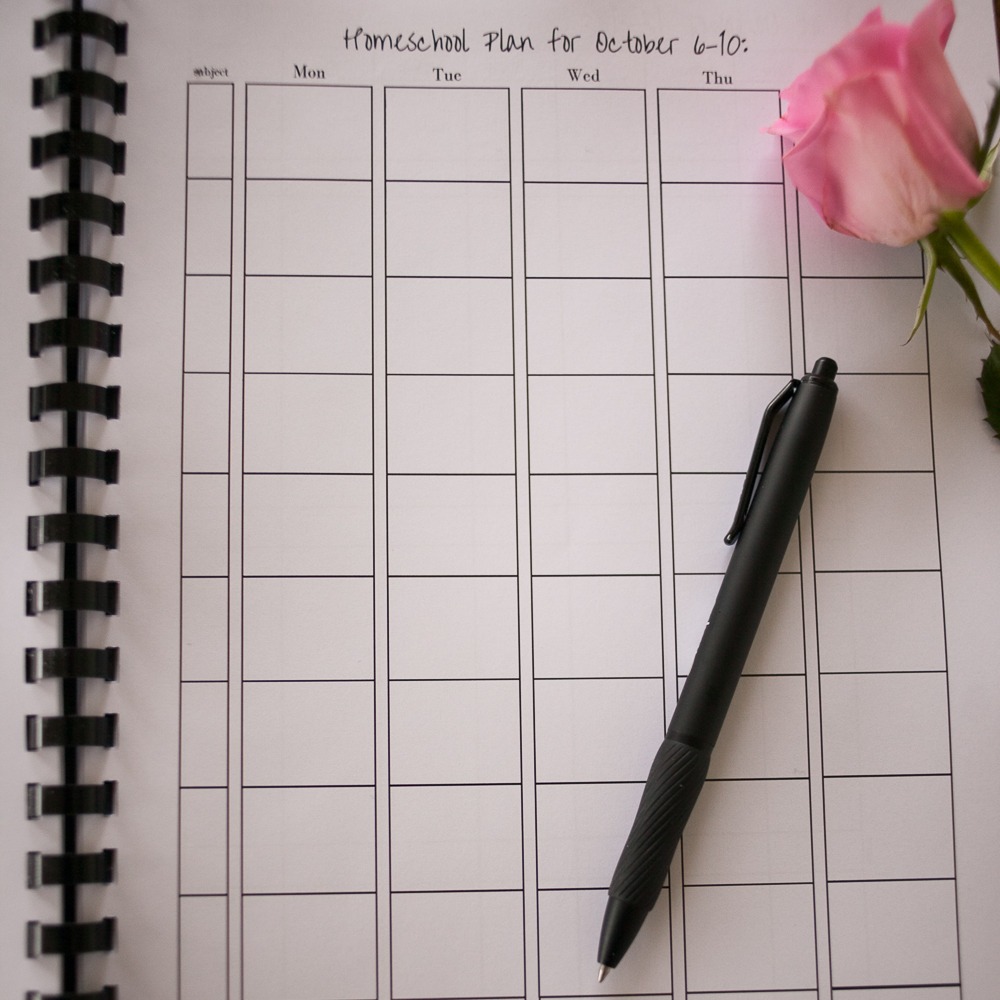
I usually use my weekly spread planner (you can purchase it here on my website!) to meal plan, plan out the week, AND check in with our homeschooling progress.
I make sure we aren’t falling behind on any of our subjects, and jot down what lessons each child needs to do during the week (I use a simple “check it off in the planner” system when the lesson is completed to help me stay on track and see how we’re progressing at a glance during the week).
I have a post with a lot more detail about our daily and weekly homeschool routine, so if this topic interests you, you can check that out.

Launch the Homeschool Year with Connection as a Focus:
During our “soft start” week, I complete a questionnaire with each child. This serves as both a record of their life at consistent intervals, but also it does double duty to help me have some fresh ideas of how to connect with my kids.
In my Student Interview Printable, I ask about a variety of favorites (dinner, drinks, treats, things to do with different people, games to play, etc), along with recording what the kids are interested in learning about.
I usually try to plan something each week for each child that utilizes the information I collected in this interview. In my planner, I have a habit tracking section each week that I use to help me keep track of connection moment each day with each kid.
Having the student interview to reference back to helps me intentionally integrate opportunities for connection into our homeschooling week.
If you want a copy of the printable, drop your email address into this form and I’ll send it over!
Launch the Homeschool Year with Celebration:
Whether it is a special breakfast on the first morning of your “hard start” to the school year, or a nice dinner to wrap up the end of this 3-week launch the homeschool year system, I love to celebrate the start of a new school year!
Personally, I lean toward a celebration at the end of week 1 of the academic focus, as it integrates into our family’s schedule and it feels like a reward for the previous 3-weeks of work.
But however you want to do it, I encourage you to celebrate getting the school year up and off the ground.

Here’s to a Wonderful Homeschooling Year!
I’d love to hear if you have developed a “launch the homeschool year” process that works for you, or if you plan to give my model a try. Please leave me a comment below with your thoughts and ideas!
And if this post has been helpful for you, please share it with someone you think it would benefit, or post it on Pinterest or your social media account. Your support in that way helps this blog flourish!
And if you’re looking for other homeschool content or resources, check out my one-hour Masterclass for helping homeschooling moms manage their time and life while they are homeschooling (being taught live August 14, 23, and 27, 2025), or my super handy Homeschool and Life Admin Planner (digital download).
And if you want more in-depth encouragement around managing yourself while you manage your homeschooling, check out my Conquer the Chaos Mini-Course (Masterclass style). It is full of practical, tested methods for moving from “chaos” to “calm confidence” in your home and homeschooling.
Conquer the Chaos Mini-Course: Time Management, Home Organization, and Mindset Strategies for Homeschooling Moms
Conquer the Chaos is a practical, inspiring, and grace-filled mini-course designed to help homeschooling moms bring calm, clarity, and confidence back into their days. Learn simple time management strategies, home organization systems, and mindset shifts that actually work with babies and toddlers underfoot.