
How to Make a Baby Nursery In a Tiny Space
Are you about to bring home a baby and wondering how to make a tiny nursery space in your already small home? Sometimes it can feel like babies come with a LOT of stuff! But they don’t have to, and you can make a lovely baby nursery in a tiny space.
You can make a tiny nursery space almost anywhere, really! It will take a bit of creativity. And intentionality. It will take a willingness to do what works for you, regardless of cultural norms. Most likely, it will also take some trial and error!
As a quick side note, though, I would encourage you: homes and spaces are constantly evolving! So set up your baby’s nursery and use these tips and ideas. But also recognize, at least in my experience, it is normal to do some rearranging and refiguring every month or two throughout the baby’s first year.
In small spaces, you’ve got to maintain your flexibility and creativity!
But it is entirely possible to live happily in a small space with kids. And babies truly don’t need a ton of space dedicated to them. In this post, I will show you how we have added our third and fourth child to our small home and it’s overall been a really smooth process!
This post may contain affiliate links, which means I make a small commission at no extra cost to you. See my full disclosure here.
Our history bringing babies home to small spaces:
My husband and I have had four babies, and we’ve had what is considered “small” or “tiny” homes throughout adding our children into our living space.
When we brought our first baby home from the hospital, we had one bedroom and an en suite bathroom to call our own in a shared four bedroom house. We worked for a ministry training young people at the time, so we shared the house with 16 other people.
By the time we had our second baby, we lived in a 450 square foot garage conversion apartment. It had one bedroom with an en suite bathroom, and a tiny bonus room that served as the utility room, storage room, and our children’s bedroom.
When we had our third baby, we had moved into our largest living space yet: a 650 square foot cottage with a 100 square foot detached bonus building. It has two bedrooms, one bathroom, huge sliding doors in the common area to brighten everything up, a very large deck for indoor/outdoor living, and then that fantastic, flexible bonus space.
And now our fourth baby has been born, and we are still living in that sweet country cottage.
Throughout all these babies, we’ve never had a space to devote an entire room as a nursery. We’ve made do carving out tiny spaces to dedicated to our babies. And it’s worked.
We’ve learned some things along the way, and we hope this post is helpful for you!
It’s normal (and recommended) to share your room with your baby
First, the concept of a baby needing their own bedroom is not necessarily “normal” when you consider human history and the various cultures around the world.
In the last 50 years, average house sizes in the USA have increased by 1,000 square feet (from about 1,500 square feet to about 2,500 square feet). And while the amount of space for a family has been increasing, common family sizes have decreased.
In the 1970s, it was common for families to have four kids. Now, the average family has half that many children. And looking at average house sizes around the world, there is a wide span of sizes for new homes being built.
Which means, people have been and are currently creative with how they make space for their babies. Some people are bringing babies home into tiny spaces and creatively creating nursery zones for them.
Safe sleep recommendations for infants encourage parents to sleep in the same room as the baby for the first year of the child’s life.
If you don’t have space for a dedicated room to be your baby’s nursery, that is totally fine. You’re in good company with much of the world’s population. You don’t actually NEED an entire room with furniture dedicated exclusively for the baby.
So save your money and your time and energy. Don’t decorate a nursery!
What you really NEED for the first month of a baby’s life:
There are a handful of basic things that your baby needs in the first month of their life for survival and safety. They are:
- diapers
- clothes
- milk
- a safe place to sleep
- a car seat
Beyond this list, everything else is really just optional. While there are certainly things that will make life more convenient or more comfortable, the baby truly doesn’t NEED that much.
I’m a big fan of a minimalist approach to stuff in life , and for me, that has included preparing to have a baby. I wrote this post about how to approach having a baby with a minimalist mindset, which you might find helpful.
I think one of the most important things is to identify what you actually need for the first few weeks of a baby’s life. Remember, you will be able to go get stuff after the baby is born if you find you truly need something.
But it makes more sense to start small and add to it as time goes on, rather than starting with a whole bunch of stuff and then having to deal with clutter.
Identify a few things you WANT to have for the baby
It is worth considering what things would truly add extra convenience or comfort. If you’ve never had a baby before, this may be hard to know. Ask around.
Ask people who have a similar approach to life as you do, and people who also live in a small space. What did they or what would they want to have for a tiny nursery space?
I encourage you to avoid initially buying big, bulky furniture, and instead consider equipping your tiny space with things you might not even put in a nursery space.
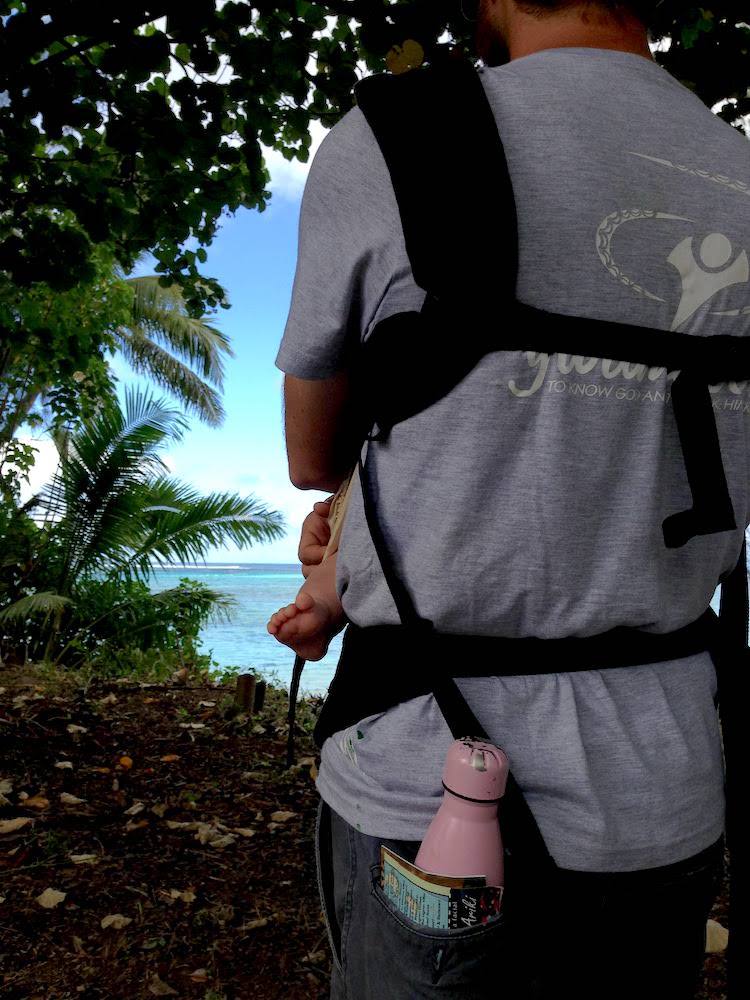
For me, I want a few options to help carry the baby. All of my babies have enjoyed being carried or “worn” on me. So investing in a carrier that I will utilize not only when I am “out and about” but also when I’m home is a high priority.
I’ve had a Moby Wrap (for when a baby 0-8 weeks and enjoys womb-mimicking carrying experiences), an Ergo carrier (for when a baby gets a bit bigger, or when I’m putting the baby on me for a carrier-nap), and a ring sling (for when I want to have a carrier but don’t want it to take up a lot of space).
(For me, the Ergo carrier is my favorite! A friend gifted me her hand-me-down Ergo when I was pregnant with Mara, and it’s been going strong for almost 7 years now. I find it the most comfortable and the carrier with the longest range of wearability – and even with a basic one, you can front carry, back carry, and hip carry!)
It is highly worth adding an over-the-door hook rack to your home for a tiny nursery space to be able to hang some helpful baby carrying devices.
Create a change caddy rather than buying a change table
Change tables frequently get marketed to new parents as an “essential item” for their nursery. Trust me, you can (and will!) change you baby in many locations during their diapering years.
You don’t need a dedicated piece of furniture on which to do this.
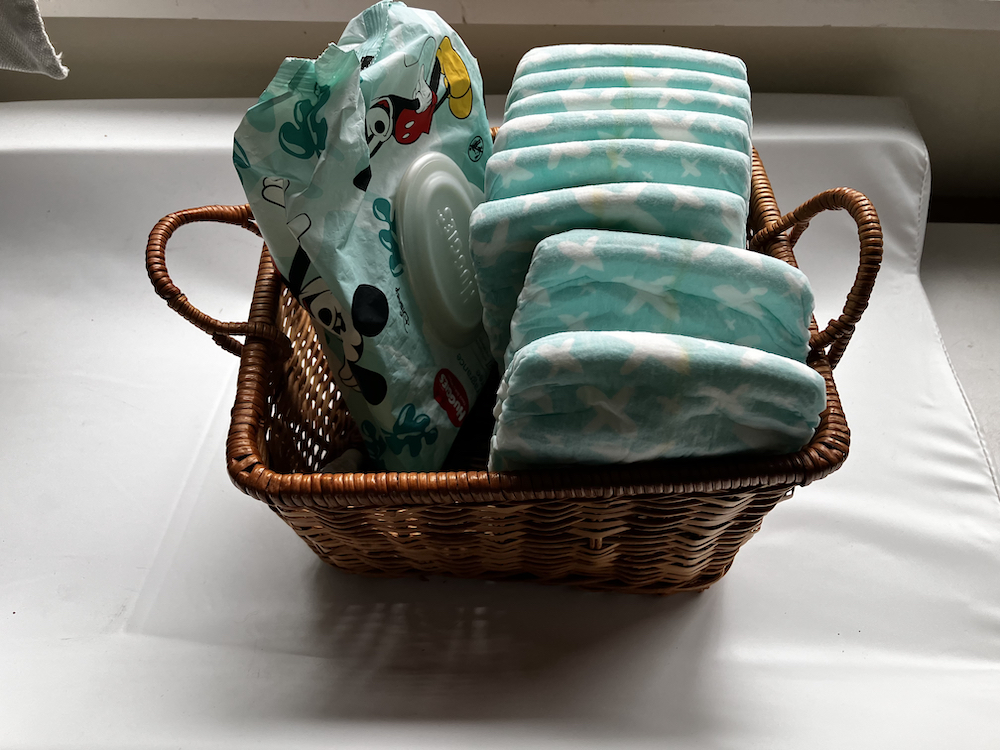
What is more helpful is having a “change caddy” that you can easily grab and use in different locations. We have a basket which holds about 10 diapers, a package of wipes, and some ointment for diaper rashes.
Since your space is presumably small, you won’t need to walk around a huge house looking for the change caddy. We keep ours on a shelf in the common area of our cottage.
We also have a wipeable foam change mat, which is nice especially for when baby’s are quite little. Since some of the surfaces where I frequently change the baby are hard, it’s convenient to have something with some cushion.
I regularly change the baby’s diaper on the floor, on my bed, on the couch, on a window seat in my bedroom, and on our dining room table.
The change mat usually lives under the couch (near the change caddy) so I can pull it out when I’m changing the baby on the floor. I also frequently just lay the baby down on a blanket, though, so the change mat isn’t a “must have” for me.
Utilize creative clothing and accessory storage systems for your tiny nursery space
Another piece of furniture often marketed to parents is a “baby dresser.” Like a change table, you don’t actually need a new dresser for your baby’s stuff.
First, unless you’re storing a lot of diapers in the dresser, or planning to have on hand almost every piece of clothing for their entire first 2 years of life, baby clothes don’t take up that much space.
And second, you can use space you already have creatively without needing to give up floor space for storing clothes.
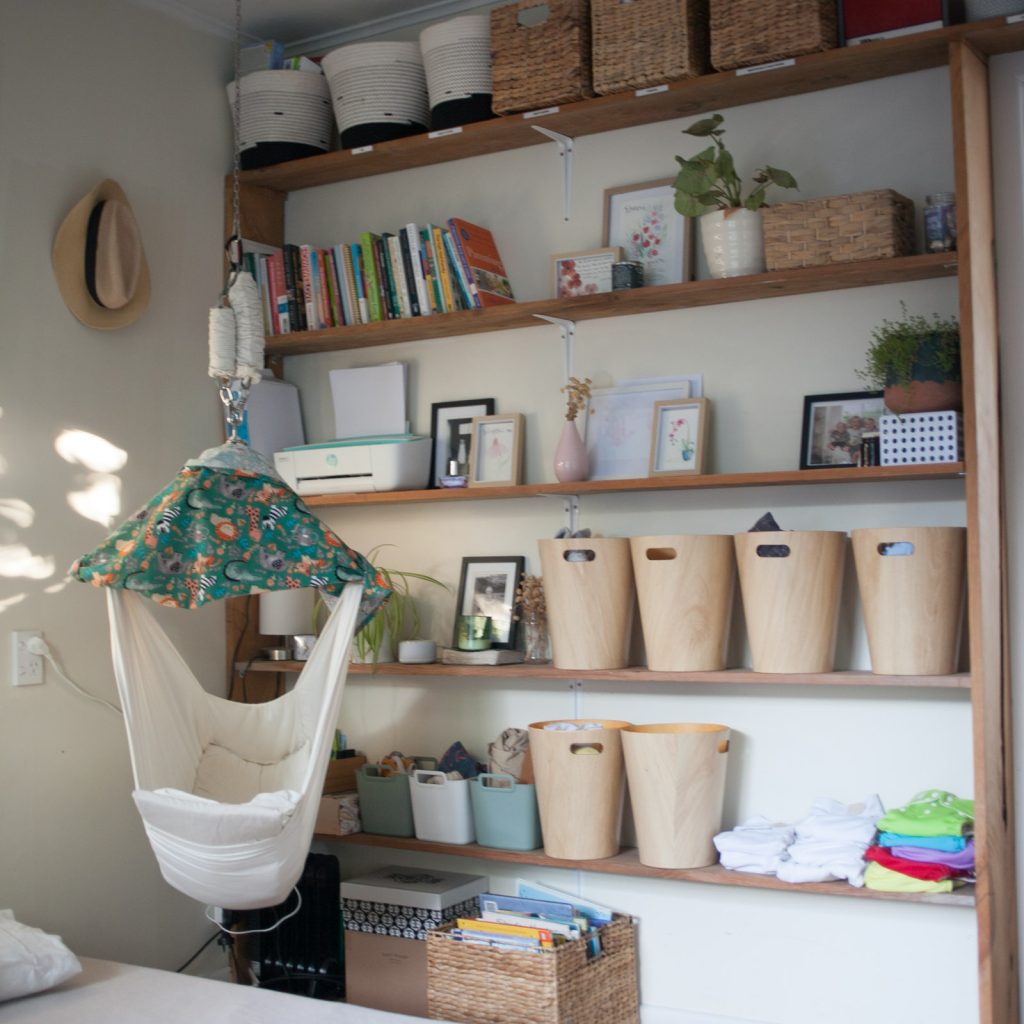
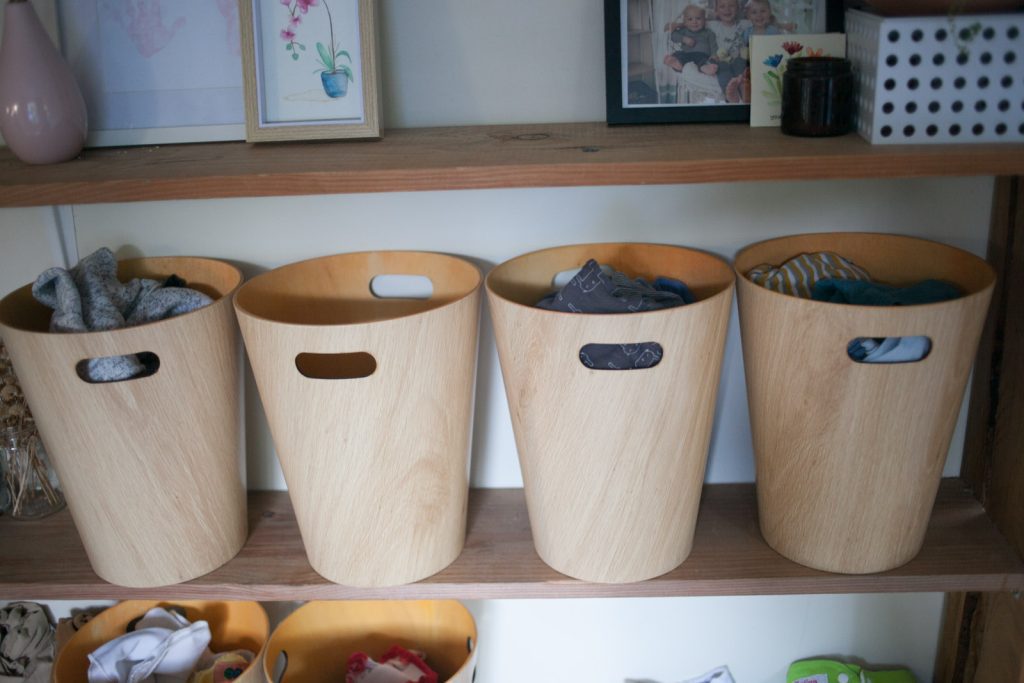
We have open shelving in my husband’s and my bedroom. I’ve used space on the bottom two shelves for baby clothes for the our third and fourth babies.
Due to the narrow depth of the shelves, I went shopping for baskets or containers that would fit on the shelves easily. I ended up with garbage baskets from the office supply section of Kmart.
The tall, relatively narrow dimensions fit perfectly. I bought six wastepaper baskets. They store all of the baby clothes currently in use. I use a bin each for:
- shirts
- bottoms
- pajama onesies
- sweaters
- cloth diaper covers
- cloth diaper extra absorbency inserts
I would encourage you to consider where you already have a little pocket of space you might be able to use for baby clothes. Some options I’d consider are:
- Utilize a pull-out tray under furniture you already have (such as your couch or your bed)
- Find baskets or bins that optimally use existing shelving (such as wastepaper bins or magazine baskets!)
- Take advantage of an over the door organizers (one with hooks might be helpful for hanging a diaper bag or baby carrier, too!)
- Consider a shoe rack with baskets that you could tuck along the end of a couch or even in a hallway if needed

Get creative and comfortable with feeding spots
While a rocking chair with arms is nice for breastfeeding or bottle feeding a baby, it truly isn’t necessary. And you don’t need a specific chair to feed the baby in for a tiny nursery space. Mamas have been feeding their babies in all kinds of places and positions for all of human history!
I recently did an in-depth post on breastfeeding tips, specifically focused on the early days of breastfeeding. But the variety of positions and suggestions on how to use pillows in that post are useful far beyond the first few weeks of a baby’s life.
I would highly encourage a new mom to focus on learning how to breastfeed in a side-lying position more than buying a rocking chair for a nursery to try to fit into your tiny space. A couch or even sitting against the headboard of a bed with pillows to prop your arms up can be at least as comfortable as a rocking chair.
Basically, anywhere with good back support can be relatively comfortable for feeding. And I like to have pillows around to prop under my elbows or under the baby to lift the baby to the right height.
Although I haven’t done a lot of bottle feeding, I would assume that feeding a baby with a bottle is more flexible than trying to get a baby to the right height and location at the breast. Therefore, it would follow that your location and position for feeding a baby are less restrictive than breastfeeding as well.
Think outside the box for sleep locations to create a tiny nursery space
Baby’s truly don’t need their own room to sleep in, especially when they are quite young. Having a little nook or a corner of a bedroom is perfect for a little baby. All you really need is a tiny nursery space.
Our kids have slept in a variety of locations and in a variety of sleeping contraptions.
Over the years, we’ve used a travel bassinet, a hammock, a traditional crib, a folding port-a-cot, a cardboard box, a purchased bedside co-sleeper, and a homemade bedside co-sleeper. Sometimes in the room next to us, and sometimes putting the sleeping furniture in a closet.
And we’ve safely practiced co-sleeping in the bed.
As long as you are using common sense safety and being aware of your baby’s developmental stage, I think there are SO many options for how and where a baby sleeps.
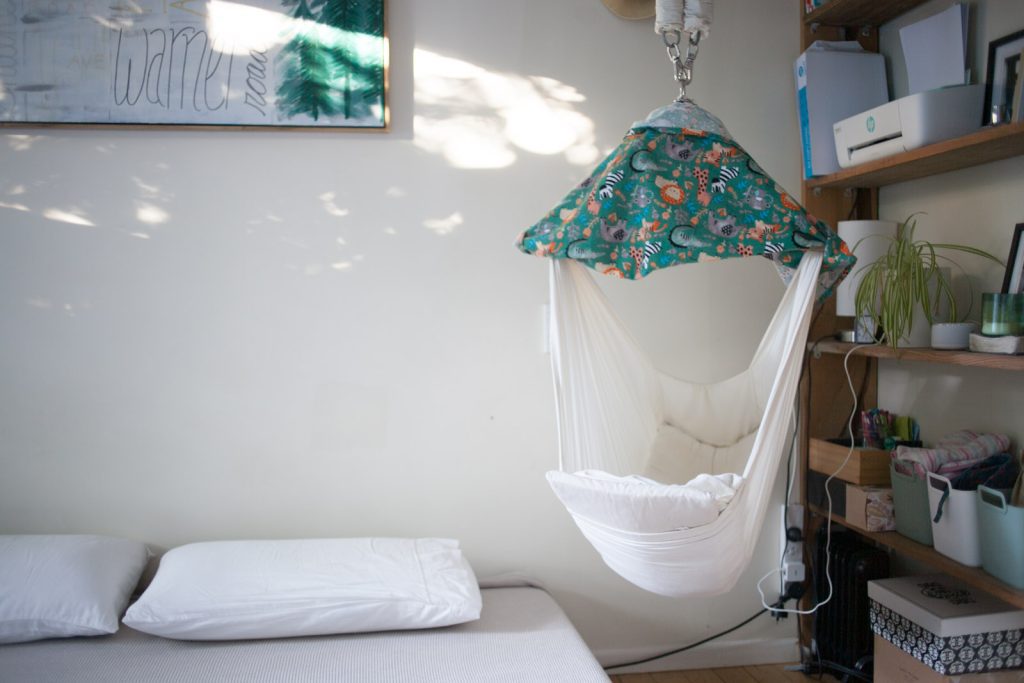
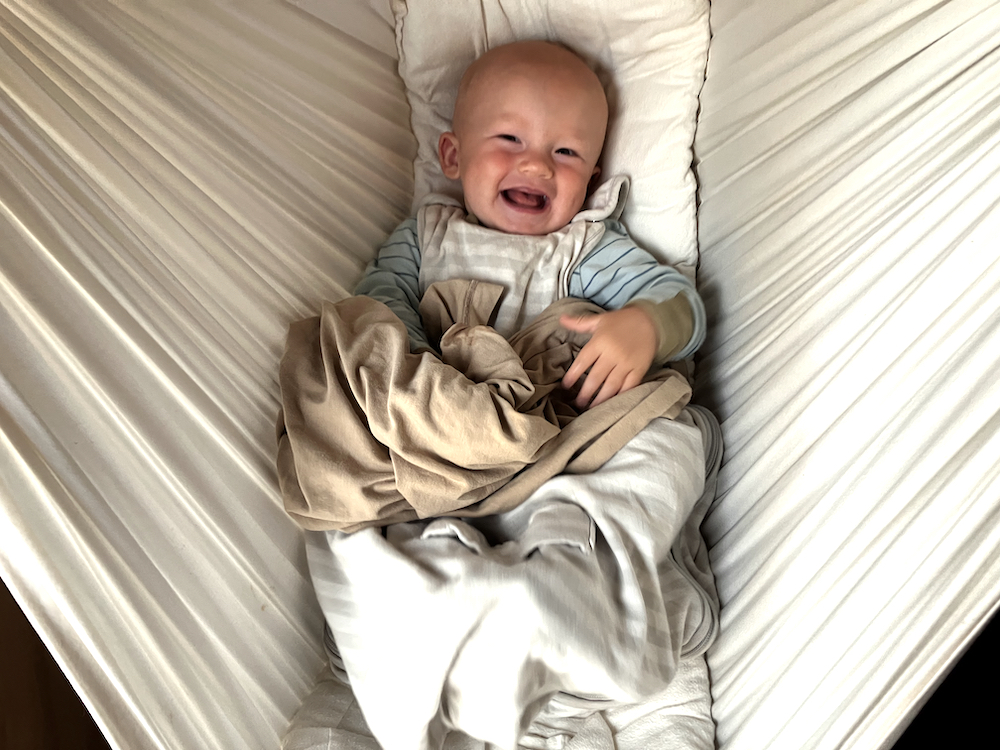
With our current baby, we have been using an infant sleep hammock almost exclusively for the past 5 months. The hammock has been a great system for us, as it is easy to move.
At night, Thad sleeps in the hammock in our bedroom, hung from a hook in the ceiling. For naps, we move the hammock either outside to the porch or in to the sleep out cabin off the side of the deck.
We have a baby monitor set up, so I can hear him during his naps. But it is definitely the most peaceful and quiet place for a baby to sleep when there are three other kids in the 650 square foot cottage playing and homeschooling!
When we recently went to the USA, the hammock went with us, and we were able to find places to hang it either on door frames with the door frame clamp, or on heavy duty hooks in the ceiling.
Hold off on age-specific things to keep your tiny nursery space efficient
There are a lot of things baby’s can use or are interested in for a short time. But they out grow things quickly in the first year of life!
In order to keep your tiny nursery space from being crowded, I recommend holding off on getting something until you actually need it for the baby, and then get rid of it as soon as it is no longer useful.
One of my favorite ways of doing this is borrowing items as much as possible. But you could also purchase and then resell. Or, if you are planning a baby shower, asking for the amount to purchase an item in a gift card designated specifically for that item.
I’ve compiled a list of things that are common baby gear, but they fit a relatively small window of time. I’ve included the ages that my kids used the items for a reference point:
- bouncy chairs (newborn to five months)
- baby swings (newborn to four months)
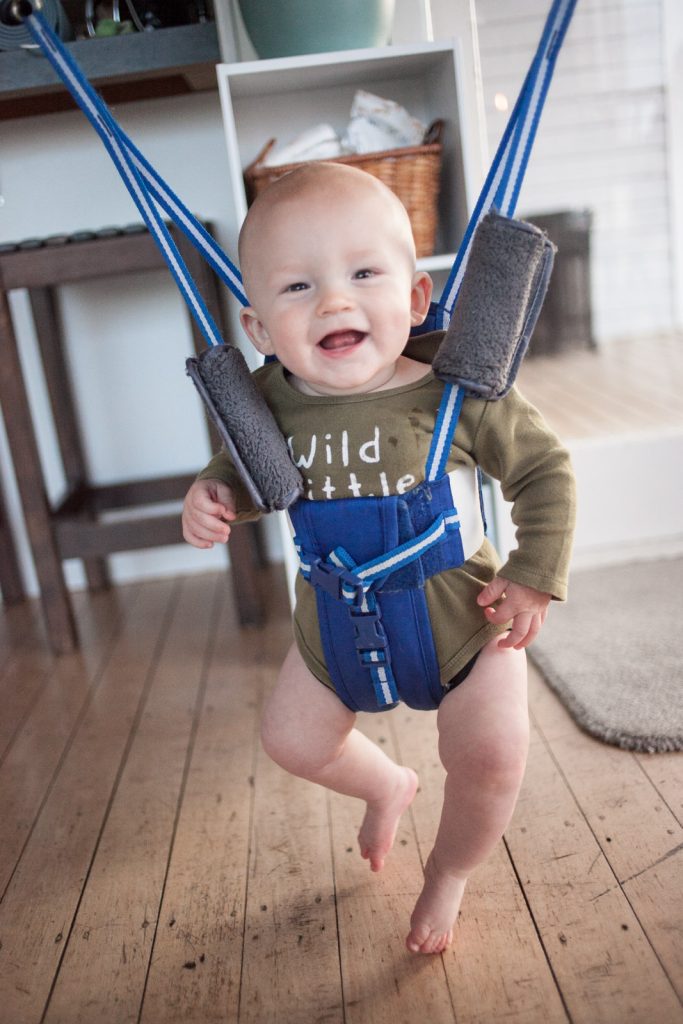
- jolly jumper (six months to eleven months)
- teething toys (four months to nine months)
- bumbo/booster type chair (six months and upward)
- baby activity gym for lying on the floor (two months to five months)
- baby bath (didn’t ever use, but newborn until the baby can sit up around six months approximately would be my guess)
- board books (nine months to two years)
- teething bibs (two or three months until five months)
- baby clothes (usually four to six weeks for newborn clothes, and about two to three months for each subsequent size)
- stroller (three months until toddlerhood)
- ergo baby carrier (from day 1 with infant insert – insert gets removed when baby is about 3 months old and ergo keeps getting used until kids are three or four years old)
- saucer activity gym (five months until nine months)
Use foldable/collapsable options to maximize your tiny nursery space
Whenever possible, I recommend trying to get or borrow things (when you truly need them or they developmentally are appropriate for the baby) that are versatile and foldable to make the most use of your tiny nursery space.
Since you pretty much never need ALL your baby equipment at the same time, it makes a lot of sense to have things that will collapse down and become as compact as possible for when they are not in use if you are working with a tiny nursery space.
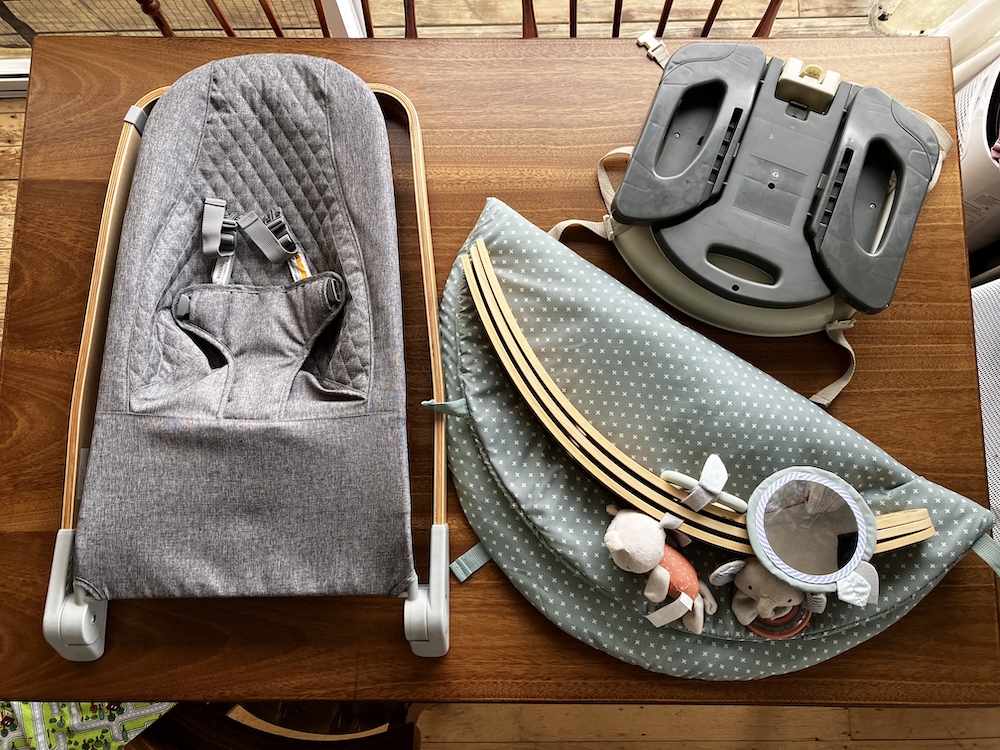
For example, if you want an activity gym for the baby to look at when laying on the floor, I suggest going for something that folds up flat.
If you want a sleeping space that is going to be most space efficient, I suggest a pack-and-play option with a bassinet and bedside sleeper which can also fold down to take on trips.
Our bouncy chair folded down almost flat so we could store it under our couch, but if I was to do it again, I’d get something like this with the rocking option as well.
And our booster seat for Lazlo folds down, which makes it WAY less awkward to use in our small dining room because it can fold down and slide under the edge of the table like a normal chair. It is very convenient and makes a lot of sense for a small space!

Questions or Thoughts?
I hope these ideas for making a tiny nursery space work well for you. I’d love to hear from you in the comments: are you preparing for a baby in a tiny space? Do you have a tiny nursery space set up? What ideas seem most useful and helpful to you?
It’s true that babies’ needs are so basic! It can be tempting to get swept up in all of the “must haves,” especially as an excited or anxious first time mom. You are wise to counsel that parents start with the basics and can always add later, when you identify a particular need or are ready for a stage-specific item. Baby gear is funny, too, because sometimes you have a bulky “lifesaver” item that you only use for a short time but can’t imagine going without. (That’s how I feel about the baby lounger that I use for just the first month.) Lending items to others and borrowing have been such a help to me in managing items and space well. Do you feel that your sense of what you really need for
your baby has been refined with each child’s arrival?
That is so true! My mom (who is not a minimalist!) talked me into getting a battery-operated baby swing when Lazlo was a baby. She’d found having baby swings to be very helpful with my siblings and me when we were babies, especially when my twin younger brother and sister were born. I used it – a lot – for about 6 weeks, and then Lazlo was past that stage, so I passed it on to another family. I did not replace it with Thad because it was always a bit bulky for my preference, and I never really felt like I was missing it. But man, it was super helpful for that one short season with the one baby!
I do feel like my preparation for each baby gets less and less, which probably means I’ve refined what I feel like I truly need. At this stage, I feel like I pull about 8 zip-up sleepers out of storage, pull out about 4 swaddle blankets, buy a big box of newborn diapers, and find my newborn insert for my ergo carrier, and that’s about all I need before a new baby comes!